How to Choose the Best Safety Light Sensor for Your Home and Workplace
In today's increasingly safety-conscious environment, the importance of "Safety Light Sensors" cannot be overstated. These devices play a crucial role in enhancing security and convenience in both residential and workplace settings. According to a recent report by the International Association of Safety Professionals, effective lighting solutions, including safety light sensors, have been shown to reduce workplace accidents by up to 30%. This statistic underscores the significance of selecting the right sensor to ensure optimal performance and safety.
Industry expert Dr. James Blakely, a noted authority on safety technology, emphasizes that "the right safety light sensor can transform the way we approach both security and energy efficiency." His insights highlight the dual benefits of these sensors — not only do they provide a reliable security measure, but they also contribute to sustainable energy practices. As we explore the various options available in the market, understanding the key features and applications of safety light sensors will empower homeowners and businesses alike to make informed decisions that prioritize safety and efficiency.

Understanding the Importance of Safety Light Sensors for Home and Workplace
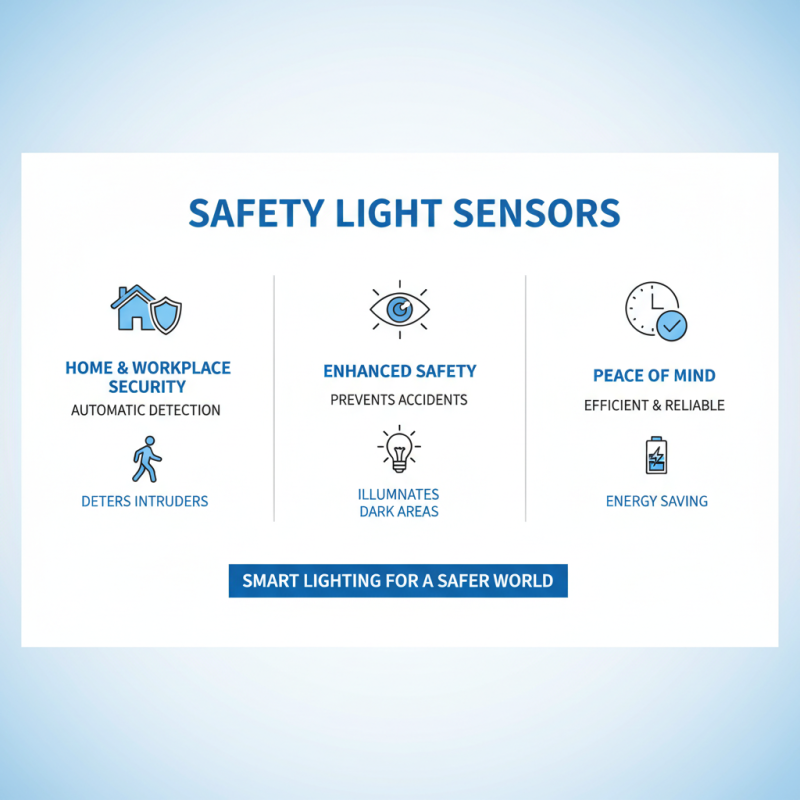
Safety light sensors play a crucial role in enhancing security and safety in both home and workplace environments. These devices automatically detect the presence of movement or changes in light levels, activating artificial lighting or alarms as necessary. This feature is particularly important in dark or secluded areas, where potential threats may linger unnoticed. By illuminating spaces only when needed, safety light sensors not only deter intruders but also provide peace of mind for occupants, minimizing the risk of accidents, such as trips and falls, in low-light conditions.
The importance of safety light sensors extends beyond mere security; they also promote energy efficiency. By automatically adjusting the lighting based on environmental conditions and occupancy, these sensors help reduce electricity consumption. In workplace settings, this can lead to significant cost savings and create a more sustainable operation. Moreover, in residential settings, they contribute to a decreased environmental footprint while ensuring that homes remain welcoming and safe. As we increasingly prioritize safety and sustainability, investing in the right safety light sensors becomes essential for creating environments that protect both people and resources.
Types of Safety Light Sensors and Their Applications
Safety light sensors play a crucial role in enhancing the security and safety of both homes and workplaces. Their applications can be broadly classified into various types, including motion detectors, photoelectric sensors, and infrared sensors. According to recent market research conducted by Grand View Research, the global market for light sensors is expected to reach $8.6 billion by 2025, indicating a growing reliance on these technologies for safety solutions. Motion detectors, for instance, utilize passive infrared technology to detect movement, triggering alarms or lights, making them ideal for outdoor security applications.
Photoelectric sensors are widely used in industrial settings, such as automated assembly lines and safety systems on machinery. These sensors work by detecting changes in light levels, which can indicate the presence of an object or an anomaly in a predefined area. A report by Research and Markets highlights that the industrial segment is projected to grow significantly, as manufacturers increasingly implement safety protocols to protect workers and improve operational efficiency. Meanwhile, infrared sensors are used in applications ranging from automatic lighting control to security systems, providing remote monitoring capabilities and enhancing safety operations in both residential and commercial environments. The increasing demand for smart home technology and automation is further driving the adoption of these sensors, making them indispensable in modern safety strategies.
How to Choose the Best Safety Light Sensor for Your Home and Workplace - Types of Safety Light Sensors and Their Applications
| Type of Safety Light Sensor |
Application |
Features |
Ideal Environment |
| Passive Infrared (PIR) Sensors |
Motion detection for security lighting |
Detects motion through heat; cost-effective |
Indoor and outdoor; areas with animal movement |
| Photoelectric Sensors |
Automatic lighting control based on ambient light |
Adjusts lighting based on light levels; energy-saving |
Common areas, parking lots, outdoor settings |
| Ultrasonic Sensors |
Motion detection for automated doors and lighting |
Can detect motion through obstacles; versatile |
Indoor areas; offices, restrooms |
| RFID Sensors |
Asset tracking and monitoring |
Identifies objects without direct line of sight |
Warehouses, retail stores |
| Laser Sensors |
Precision measurement and presence detection |
High accuracy; suitable for precise applications |
Industrial settings; manufacturing processes |
Key Features to Consider When Choosing a Safety Light Sensor
When selecting the best safety light sensor for your home or workplace, there are several key features to consider that can significantly impact its effectiveness. First and foremost, the sensor’s detection range is crucial; it determines how far from the sensor you can be detected. A wider range is especially beneficial for larger areas, ensuring that all corners are adequately monitored. Additionally, look for sensors with adjustable sensitivity settings, which allow you to fine-tune the detection capability based on specific environmental conditions, minimizing false alarms triggered by pets or fluctuating light levels.
Another important feature is the type of light source used. Many safety light sensors come equipped with LED lights, which not only consume less energy but also have a longer lifespan compared to traditional incandescent bulbs. Furthermore, consider the sensor's response time; an efficient sensor should activate almost instantly upon detecting motion or changes in light. Lastly, consider the ease of installation and integration with existing security systems, ensuring that the sensor is user-friendly and fits seamlessly into your overall safety plan.
Safety Light Sensor Features Comparison
Installation Guidelines for Maximum Effectiveness of Safety Light Sensors
When installing safety light sensors, proper placement is crucial for optimal performance. According to a 2022 study by the National Institute of Standards and Technology (NIST), the effectiveness of motion-sensing technologies can be compromised by factors such as incorrect sensor positioning and suboptimal ambient light conditions. For residential use, sensors should be mounted at a height of 6 to 8 feet to maximize their detection capabilities, ensuring that they cover the most common entry and exit points around the property.
Moreover, the orientation of safety light sensors plays a significant role in their efficacy. A report from the International Association of Professional Security Consultants (IAPSC) stresses that sensors should be directed towards areas with high foot traffic and away from potential obstructions like trees or structures that may block movement detection. Regular maintenance, including cleaning the lenses and checking for correct alignment, can also enhance sensor performance. Implementing these installation guidelines not only improves safety but can also extend the lifespan and functionality of the sensors, aligning with best practices recommended in contemporary security technology reports.
Maintenance Tips for Ensuring Longevity and Reliability of Sensors
When it comes to ensuring the longevity and reliability of safety light sensors in your home and workplace,
regular maintenance is crucial. Over time, dirt, dust, and other environmental factors can accumulate on the sensors,
leading to reduced functionality. To keep them in optimal condition, it's recommended to clean the sensors periodically with a soft, dry cloth.
Avoid using harsh chemicals, as these may damage the sensor's delicate components.
Additionally, checking the alignment of your sensors is vital for their effectiveness. If the sensors are misaligned,
they may not detect movement accurately or may not activate the lighting as intended. Regularly inspect the placement of your sensors and adjust them as needed
to ensure they cover the appropriate areas. This simple step can significantly enhance the sensors' performance and reliability.
Finally, monitor the power supply and connection points of your safety light sensors. A secure and stable power source is essential
for consistent operation. Consider replacing batteries as per the manufacturer’s guidelines if they are battery-operated.
Implementing these maintenance tips will help prolong the life of your safety light sensors and enhance their reliability in protecting your space.